
Garlic is a staple used for flavor in the culinary industry. Whether it is ready-made food or freshly prepared items, garlic can add a magical touch.
Before garlic is distributed, it must undergo various processing steps to extend its shelf life. Therefore, selecting garlic is not just about appearance.
Processing companies have to evaluate, test quality, and proceed with processing only if needed. For processing companies, five major indicators are discussed. You should learn about those indicators and choose the right garlic type based on our experts’ tips.
Factor 1: Clove Size and Uniformity: Maximizing Yield and Processing Efficiency

One of the most powerful factors is the clove size. Let’s keep an eye on major aspects and know their applications.
Why does clove size matter?
In food processing, it is not the clove’s shape or color that matters, but its size. Processing involves a wide range of operations, such as processing, dehydration, peeling, chopping, and crushing.
An adequate clove size offers the following benefits:
- There is a higher usable yield per kilogram and reduced time processing.
- Reduced peeling losses increase the overall garlic productivity.
- More efficient mechanical processing can elevate the cost-effectiveness.
- Consistent flavor distribution in formulations makes food tastier and more enjoyable.
If your garlic cloves are small, they produce more waste and reduce efficiency. Therefore, you should focus on the clove size.
Ideal clove size

Garlic clove size is always a debate, but it depends more on the industrial processing. Several companies have the following preferences regarding sizes.
- Large to extra-large cloves as they increase productivity and reduce waste.
- Low clove count per bulb. There should be 4–6 cloves.
- Consistent clove dimensions across batches increase the efficiency.
Ideal clove size depends on the company’s preferences.
Problems caused by clove size uniformity
More than clove size, its uniformity is what matters. If you have a large clove size, the whole production should have the same size. (No changes!)
Suppose clove sizes are not uniform. In such cases, you can feel the following problems.
- Uneven peeling due to incorrect size can cause higher reject rates.
- Inconsistent chopping or mincing results from the inconsistent sizes.
- Variable flavor strength between batches is a major issue.
- Increased downtime for equipment adjustments as there are small to large clove sizes.
Factor 2: Bulb Dryness and Moisture Content: Protecting Shelf Life and Food Safety
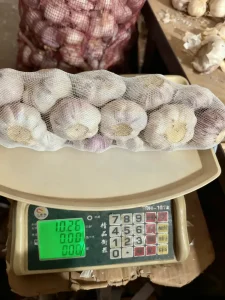
Dryness and moisture content play a significant role in processing. Let’s discuss how they can impact the overall garlic quality.
Role of Dryness
Dryness is a key indicator of garlic’s overall quality and shelf life. Processing Companies always assess the moisture content and the risk of sprouting and molding in garlic. Usually, a low moisture content and high dryness provide a firm surface and better quality.
In food processing, dryness affects the following aspects.
- Storage stability
- Risk of microbial growth
- Suitability for mechanical processing
- Transportation losses
A high moisture level can lead to rapid growth and sprouting. It leads to decreased shelf life.
Optimal Moisture Levels
There is no definitive criterion for determining the moisture levels you need. It varies and depends on the companies and the moisture levels they want.
Here are a few indicators of adequate moisture levels.
- Well-dried outer skins indicate the optimal strength and moisture levels in the garlic.
- No visible dampness or condensation means the garlic is adequately dried.
- Firm cloves with no softness
- The neck is completely sealed with no green tissue.
To achieve this level of moisture, you need to monitor post-harvest curing for 2-4 weeks.
Risk of High moisture garlic
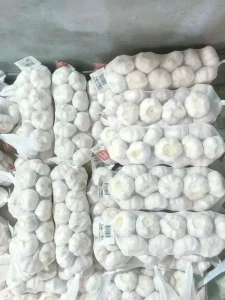
Dryness is a necessary factor and needs attention. What if there is no adequate moisture? What causes it? There can be a few side effects of inadequate dryness.
For example:
- Faster spoilage during warehouse storage as the sprouting occurs rapidly.
- Increased mold contamination because of fast microbial growth in the environment.
- Reduced shelf life for processed products as the moisture causes contamination or molding.
- Higher rejection rates at destination ports due to garlic not meeting quality standards.
Factor 3: Pesticide Residue Compliance: Meeting Global Food Safety Standards
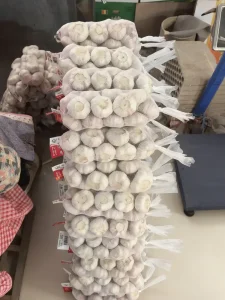
Pesticide compliance is always the primary factor, whether locally or globally. If you are an exporter and want to buy from China, compliance is always a necessary factor.
Let’s understand how pesticide compliance matters.
Why does pesticide compliance matter?
Pesticides are pest killers that can cause reduced garlic growth. But many pesticides are super toxins. They affect the human body and cause harmful health side effects.
When exporting garlic, your entire shipment can be rejected if your pesticides exceed the limits. Therefore, it is necessary to keep pesticide use within the required limits.
Key markets to consider
Some countries may be lenient about pesticide use, while others have strict verification criteria.
Here are a few markets to watch.
- European Union
- United States
- Japan
- South Korea
- Middle East, such as the GCC countries
Even trace levels of non-approved pesticides can result in shipment rejection.
Common pesticide risks
When sourcing garlic, consider the following pesticide risks.
- Use of non-approved pesticides results in non-compliance and rejection during export/import.
- Over-application close to harvest increases the chances of side effects.
- Improper post-harvest chemical treatments can clearly indicate the use of pesticides.
- Residue accumulation occurs during storage in warehouses.
Best Practices for Ensuring Compliance
Food Processing Companies should err on the side of caution by ensuring timely testing.
- Third-party laboratory test reports ensure the garlic is fully compliant.
- Residue analysis for target markets can give exact values.
- Traceability from farm to shipment ensures the safety of shipments.
- Clear documentation of pesticide usage can get instant clearance at the customs borders.
Factor 4: Garlic Variety and Flavor Strength: Consistency in End Products
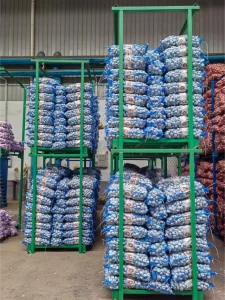
Garlic varieties vary from region to region. However, there are two key varieties with their relevant quality features. Let’s understand more about the garlic varieties.
Importance of flavor consistency
Garlic is not just about the aroma; it’s also about flavor consistency and quality. Flavor intensity and consistency are critical, as consumers expect the same taste from batch to batch. It is especially important for branded products that require a high-end taste.
Different garlic types and flavors vary depending on:
- Allicin content
- Pungency level
- Sweetness or bitterness
- Aroma intensity
Hardneck vs. softneck varieties
There are two main varieties of garlic. Most food processors offer a hard-neck variety because of its stronger aroma and pungent taste.
Hardneck variety has the following features:
- A stronger flavor and a powerful aroma enhance the food’s taste.
- Larger cloves are typical features of the hardneck variety.
- Higher allicin content delivers high antimicrobial and health benefits.
- Preferred for paste, sauces, and seasoning blends.
Softneck varieties have the following taste features.
- Better storage stability when stored in the warehouses.
- Milder flavor for the different cooked foods.
- Often used in dehydrated products and powders for consistent quality.
Risks of mixing garlic varieties
Having a single variety of garlic is crucial because of consistent taste. What if you get a mixed variety? Here are a few risks associated with mixed garlic varieties.
- Inconsistent flavor intensity
- Variations in color after processing
- Unpredictable cooking behavior
Factor 5: Physical Integrity and Defect Rate: Reducing Waste and Downtime

Processing Companies also focus on physical integrity. It ensures you have the right quality. Let’s discuss how physical integrity matters.
What does physical quality mean?
In addition to size and variety, processing companies also consider the external structure. They check color and structure. It ensures there are no defects externally.
A minor defect can disrupt processing and increase overall defect rates.
Here are a few things to check for physical integrity.
- Mold or black spots are visible on the surface.
- Soft or hollow cloves
- Mechanical damage
- Sprouting or internal greening
Impact of effects on processing lines
First, ensure there is no physical damage or defect. What if there are defects? You can expect the difficulty in processing due to the following reasons.
- Jam peeling and chopping machines
- Increase manual sorting requirements
- Contaminate otherwise good batches
- Reduce final product yield
Acceptable defect thresholds
There is no definite ratio of the defect rates. However, you should consider the following defect thresholds.
- There should be fewer than 2–3% defective bulbs from the overall shipments.
- Zero tolerance for active mold can help prevent future hindrances during storage.
- No sprouted or decayed cloves means the premium quality and easy processing.
Conclusion
Whenever buying garlic from the Chinese suppliers, look for the major factors. Determine whether it can be processed more effectively or whether it may require extensive cleaning and drying before processing. Moreover, you should contact the reliable suppliers who offer quality garlic.
Do you want to purchase quality garlic from the top-rated suppliers? Fenduni Garlic suppliers have a long history and serve consumers and companies worldwide. Our fresh garlic, meeting international standards, delivers high performance during processing. Contact us right away to get your garlic supply!